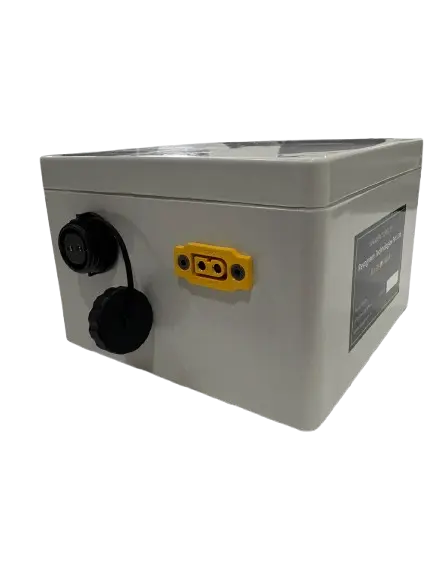
Batteries for Counter-UAS and Electronic Warfare Equipment: High-Drain Power That Doesn't Interfere With the Mission
A counter-UAS or electronic warfare battery has a strange job. It idles for hours while the receiver listens, then must deliver hundreds of watts to a jammer within milliseconds of a detection, hold that output for as long as the key is pressed, and do it again an hour later. Most packs are sized for one of those regimes. Few are built for both.
The failure mode is rarely dramatic. It is a transmit burst that clips because pack voltage sagged below the amplifier's rail. It is a BMS that trips on a current spike it was never told to expect. It is a receiver whose noise floor rises because the battery's own electronics are radiating. Each of these shortens range or breaks an engagement, and none shows up on a datasheet capacity figure.
The counter-UAS load profile: hours of standby, then a burst
Two regimes, one pack. Detection equipment, whether an RF sensor, radar or electro-optical tracker, draws a modest, steady current for the whole watch. Jamming equipment draws almost nothing until keyed, then pulls a large current for seconds or minutes. Peak power can be ten or twenty times the average. A pack sized on average energy alone will meet the watt-hour figure and still fail at the first burst.
Why a burst punishes weak cells. When current rises sharply, terminal voltage drops by current multiplied by internal resistance. A cell near its rated current, or cold, or aged, shows a larger drop. If pack voltage falls below the amplifier's minimum rail, the transmitter drops out mid-burst or output power collapses. The operator sees a jammer that "works on the bench but not in the field", and the cause is voltage sag.
Nuisance cut-offs. A BMS with thresholds set for a steady load will read a legitimate transmit burst as a fault, open the discharge path and reboot the equipment. The protection logic in a BMS for this duty must distinguish a high-current pulse from a short circuit. That means separate peak and continuous current limits with time windows, and an under-voltage trip that filters transient sag. These are firmware decisions, and they must be made against the real transmit profile.
Cell selection and parallel-group sizing for burst current
High-drain Li-ion over energy-dense NMC. Energy-optimised NMC cells give the most watt-hours per kilogram, which is attractive for a man-portable set. But their resistance is higher and their continuous discharge rating is a few times capacity at most. High-drain Li-ion cells trade some capacity for much lower resistance and a continuous rating of ten times capacity or more. For a jammer, low resistance is worth more than the last few percent of capacity, because resistance decides whether the burst holds voltage.
Sizing the parallel group. The parallel count is set by peak current, not run-time. Take the transmit current at the pack terminals, add margin for cold-temperature resistance rise and ageing, then divide by the per-cell current that keeps the cell inside its temperature limit. Only then check whether the resulting capacity covers the standby hours plus the expected bursts. In practice the burst sets the parallel count and run-time follows.
Interconnects matter too. Low-resistance cells are wasted if the nickel strip or connector adds milliohms back. Revogreen sizes interconnects and discharge FETs for the pulse current and validates the pack under the customer's actual keying pattern.
EMI discipline: a battery that stays quiet on a sensitive receiver
The battery is inside the RF environment. A detection receiver is trying to hear a small drone's control link at long range. Any switching converter, clock or noisy telemetry line in the same enclosure raises the noise floor it works against. A battery that adds a few decibels in the wrong band has quietly cut detection range, and nobody will trace it to the pack unless they look.
Layout and shielding. The BMS board uses tight current loops, solid ground planes and short return paths. The electronics sit in a shielded compartment bonded to the chassis, with the main current path routed to avoid forming loop antennas. Where a converter is required, its switching frequency is chosen to keep the fundamental and low harmonics out of the receiver's bands of interest, agreed with the integrator rather than left to a default.
Filtered telemetry lines. Every wire leaving the pack is a potential antenna. CAN, RS-485 and SMBus lines get common-mode chokes and ferrites at the enclosure wall, shielded twisted pairs, and where the architecture permits, galvanic isolation from the cell-side electronics. The DC output carries a feed-through filter so switching residue does not ride out on the rail. The goal is a pack that looks like a passive DC source at the receiver's antenna port.
Man-portable, vehicle-mounted and fixed-site: how the pack changes
Man-portable sets are a weight-per-watt-hour problem. A dismounted operator carries the jammer, the battery and everything else. The pack is typically a 4S to 8S smart battery in a compact sealed housing, built on high-drain cells so it can key a backpack jammer without sag, and designed to survive being dropped and left in the sun. We covered this class in our post on batteries for man-portable defence equipment.
Vehicle-mounted systems are a kilowatt-hour problem. A vehicle suite runs several sensors and a higher-power jammer, often on a long patrol with the engine off. The pack moves to a 48 V-class architecture, typically 13S to 16S, at kilowatt-hour capacity. The BMS gains contactor control, pre-charge for the system's input capacitance, and a CAN link into vehicle power management so the suite knows when to start the engine or shed load. Above this, Revogreen designs and builds high-voltage packs from series-connected modules, each with its own cell-monitoring electronics, under a master BMS with isolation monitoring and an interlock loop.
Fixed-site systems change the priorities again. Weight no longer matters. Cycle life and thermal stability do, because the pack floats on a charger for years and bridges mains outages. Here LFP is usually the right energy store, with a high-drain section added only if the site jammer's burst cannot be served from the LFP bank.
Environmental hardening for the deployed pack
Temperature. Revogreen packs are cold-weather rated to −30 °C and soak-tested to +60 °C. Cold is the harder case for burst duty, because cell resistance rises steeply below freezing and sag gets worse exactly when the jammer is needed. The BMS derates the allowed pulse current with temperature and reports it, so the system warns rather than drops out. At the hot end, cell heating during sustained transmit is managed by cell spacing, conduction paths to the enclosure and a transmit-time limit the BMS can enforce.
Sealing, shock and storage. Enclosures are available sealed to IP68 with potted electronics, damped cell mounting and reinforced interconnects for vibration and drop. For units stored between deployments, low self-discharge cells and a microamp-level BMS sleep mode keep the pack usable after months on the shelf, with true state of charge reported on wake.
Fleet logistics and telemetry into the system
Common formats and a universal charger. A unit running several counter-UAS and EW sets does not want a different battery and charger for each. Revogreen designs to a few common smart-battery formats across a programme and supplies a universal multi-battery charger with interchangeable harnesses, so one station serves every pack in the fleet. Each pack carries an on-pack state-of-charge indicator, calibrated against the real load profile so that forty percent means forty percent under transmit load, with the same data available over CAN, SMBus, RS-485 or UART.
Remaining transmit time, not just remaining capacity. What an operator needs is how many more minutes of jamming the pack can deliver at the current power level. Because the BMS knows state of charge, temperature and cell resistance, it can compute a remaining-transmit-time estimate and stream it to the system controller with cell voltages, pack current and any derating in force. The battery becomes a sensor the mission software can plan around. This is the thinking behind the complete power solution of pack, BMS and charger designed together.
Traceability, indigenous content and qualification support
Every pack has a record. Cells are QC-tested on receipt, packs are end-of-line tested, and each unit ships with documented test records under batch-level traceability, so a field failure can be traced to the cell lot. Revogreen designs and manufactures in Pune and supports indigenous-content requirements. Packs are designed and documented to support the customer's qualification to the standards they will typically encounter, such as IEC 62133 and IEC 62619 for safety, UN38.3 for transport, and environmental testing derived from DO-160 or the customer's own specification. Prototyping at low quantities lets an integrator validate a pack on the real equipment before production. See our overview of batteries for defence applications.
Made in India, engineered for the counter-drone mission
Revogreen Technologies has delivered more than 30,000 battery packs to over 100 clients since 2021. For counter-UAS and electronic warfare equipment, that means defence equipment battery packs built from high-drain cells, EMI-disciplined electronics and a BMS tuned to the real transmit profile, delivered with the charger and telemetry the system needs. Requirements are captured under NDA, the pack is validated on the customer's platform, and production follows with full traceability. Explore our Defence & Aerospace work and our special-purpose battery packs for unusual load profiles.
Looking for Custom Battery Solutions?
Revogreen Technologies designs application-specific battery systems for drones, defence, robotics, marine and industrial applications.
Get in TouchDefenceBatteries for Man-Portable Defense Equipment: Every Gram Rides on Someone's Back
Lightweight custom battery packs for radios, jammers, optics, and soldier-carried systems — weight per watt, silent operation, and rugged reliability. Made in India by Revogreen Technologies.
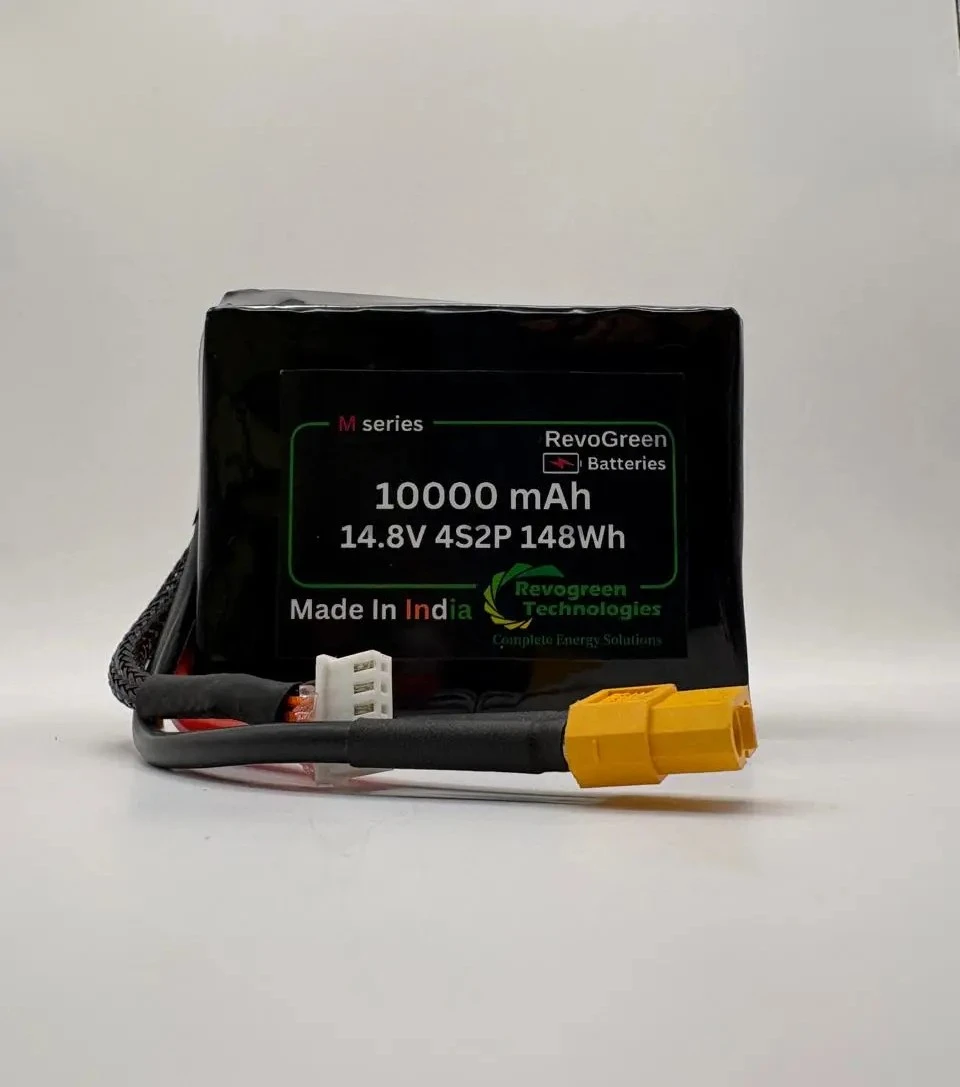 Defence
Batteries for Surveillance Systems: Endurance Is the Entire Job
Long-duration battery packs for surveillance, border monitoring, and remote sensor systems — endurance, cold-weather operation, and smart BMS health reporting. Made in India by Revogreen Technologies.
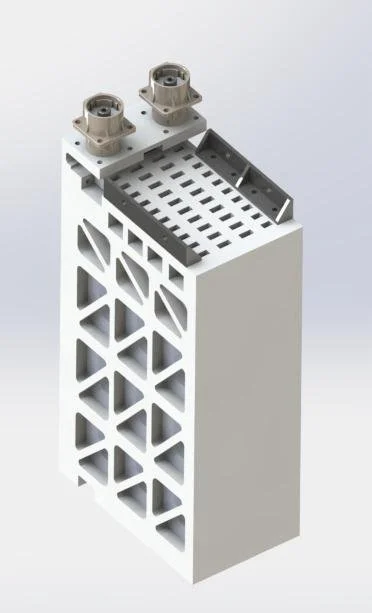 Defence
Batteries for Defense Applications: Why Off-the-Shelf Packs Fail — and What to Use Instead
Why off-the-shelf batteries fail in defense equipment, and how custom lithium battery packs with smart BMS deliver mission-critical reliability. Made in India by Revogreen Technologies.