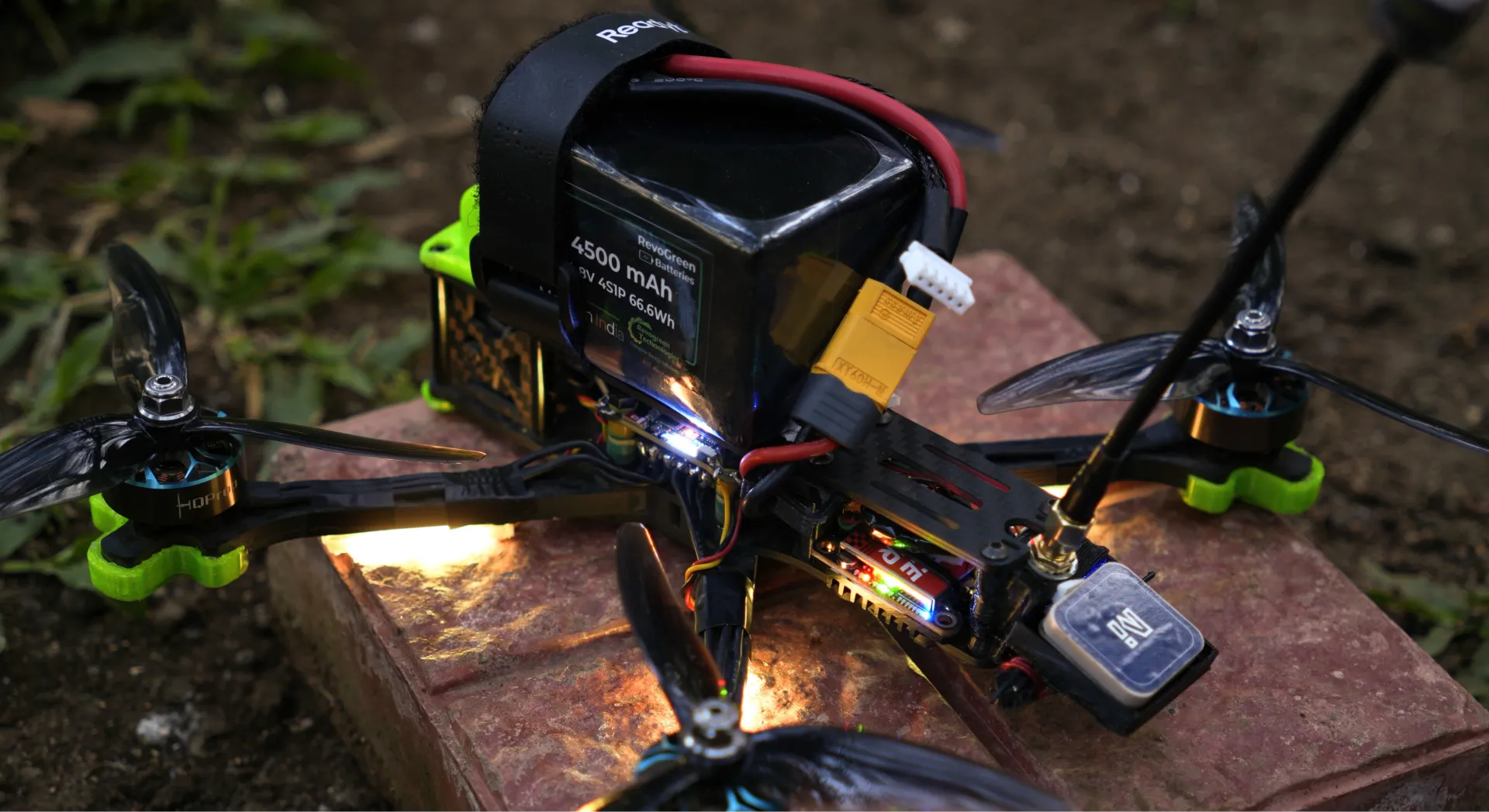
Batteries for Heavy-Lift and Agricultural Drones: 12S–14S and Beyond, 30–50 Ah, and the C-Rate That Actually Matters
Your spraying drone lifts 20 to 40 kg of tank and payload, hovers for twelve minutes, lands, and must be airborne again before the operator finishes refilling. The battery is the part of that loop you cannot hide. If it sags, the flight controller lands early. If it runs hot, its life halves. If it charges slowly, you need three times as many packs.
Many heavy-lift and agricultural drone programmes in India start with a 6S pack scaled up, then discover it cannot be scaled. The current is too high and the duty cycle destroys the cells in a season. This post explains what changes at 12S, 14S and above, what a 30 to 50 Ah pack costs you in mass, and which C-rate figure you should design to.
Why a heavy-lift or agricultural drone battery moves to 12S, 14S and higher
Hover power sets the current. A multirotor at 40 to 60 kg all-up weight needs several kilowatts just to hover. Depending on disc loading, 8 to 12 kW is realistic with a full spray tank. At 6S, around 22 V, that is 400 A or more. No practical connector, wire or ESC carries that continuously. At 12S (44.4 V nominal) the same power is roughly 200 A. At 14S (51.8 V) it is closer to 170 A. Higher voltage gives you no more energy, only a current you can engineer for.
Losses scale with the square of current. Wiring, connectors, ESC MOSFETs and interconnects all lose power as I²R, so halving the current cuts those losses by four. Lighter cable at 170 A also gives mass back as payload.
Above 14S the design changes character. Cargo platforms at 18S, 24S and beyond need pre-charge, contactor control and cell-level monitoring built into the pack. Revogreen builds standard smart formats from 2S to 28S and modular high-voltage packs above that; see the sister post on scaling a drone battery to a high-voltage pack.
Capacity versus mass: what a 30–50 Ah pack really buys you
Every kilogram of battery is a kilogram of chemical you do not carry. A 14S 30 Ah pack stores about 1.55 kWh and, built with high-drain cells in a sealed enclosure, typically weighs in the region of 9 to 11 kg. A 50 Ah pack at the same voltage is roughly 2.6 kWh and 15 to 18 kg. The larger pack flies longer, but it also raises hover power because the aircraft is heavier, so the gain is not proportional to capacity.
Do the sums with your own hover curve. If your platform draws 9 kW at 45 kg and 10 kW at 51 kg, the 30 Ah pack gives about 10 minutes to a 20 percent reserve and the 50 Ah pack about 12.5 minutes. You paid six kilograms for two and a half minutes. For a sprayer that empties its tank in ten minutes, the smaller pack is often right; for a point-to-point cargo drone, the larger one is. We settle this before any cell is chosen, using the method in our guide on how to specify a custom battery pack.
Continuous versus burst C-rate, and which cells survive it
The datasheet burst figure is not your design number. A 30 Ah pack delivering 170 A at hover runs at about 5.7C, continuously, for the whole flight. Climb-out with a full tank or a gust correction can push that to 8 to 10C for a few seconds. Your pack lives at the continuous number, and that is what heats the cells.
Cell selection follows the continuous rate. Standard NMC cells give the best energy per kilogram but are typically rated for a few C continuous. Pushed at 5C for twelve minutes, twenty times a day, they run hot, sag and age fast. High-drain Li-ion cells have lower internal resistance and thicker current collectors. They give up some energy density but hold voltage under load and make far less heat at the same current. For most agricultural and heavy-lift platforms we choose a high-drain cell and set the parallel group count so the continuous rate per cell sits inside its rating with margin for a hot day. A pack that sags 4 V under load hits the low-voltage failsafe with usable energy still inside it.
The agricultural duty cycle is harder than it looks
Count the cycles honestly. A spraying season means 10 to 15 minute sorties, 20 to 40 of them a day, for weeks. That is 1,000 or more deep cycles in one season, each followed by a fast charge. Cells rated for that many cycles at room temperature deliver far fewer at 45 °C, which is what a black pack on a field trolley in Maharashtra in April reaches before it takes off.
Heat is the enemy, and the pack must manage it. Revogreen packs for this duty use damped cell mounting, low-resistance interconnects and thermal paths that move heat from cell core to case. The BMS supervises temperature at multiple points and holds back charge current on a pack still hot from landing. Our high-temperature soak testing goes to +60 °C.
Chemicals, dust and wash-down are not optional. A spraying drone gets pesticide mist on every surface, then dust, then a hose. We build these packs with sealed enclosures, IP68-rated options, potted electronics and connectors that tolerate repeated wash-down. Reinforced interconnects handle rotor vibration and rough field swaps.
Thirty-minute charging and field turnaround
Fast charging is a system property, not a battery property. Four packs that charge in 30 minutes keep one aircraft flying continuously; at 90 minutes per pack you need twelve. Revogreen packs for this duty support a full charge in as little as 30 minutes, but only with a matched smart charger that reads the pack’s temperature and cell state over its data bus and adjusts current. Our post on fast charging and battery life explains how a matched charger protects cycle life while a dumb one quietly destroys it.
Plan the power source in the field. Charging 1.5 kWh in 30 minutes is a 3 kW-plus load, and several chargers in parallel is easily 10 kW. That means a generator or vehicle-mounted inverter sized for the day, not a domestic socket. We design charger and power-management hardware alongside the pack. The complete power solution approach, with battery, BMS and charger designed together, is what makes a 30-minute turnaround repeatable.
Smart telemetry to the flight controller and fleet health
The flight controller should know the true state of the pack. Revogreen smart packs report cell voltages, current, temperature, state of charge and state of health over CAN, SMBus, RS-485 or UART. Pixhawk-based controllers running ArduPilot or PX4 accept a smart battery over SMBus or DroneCAN, so the autopilot plans return-to-home on real remaining energy rather than a voltage guess. What the BMS does inside the pack is covered in what a BMS actually does.
Fleet health is a data problem. With 20 to 40 cycles a day per aircraft, an operator needs to know which pack is drifting. Cycle count, capacity fade, cell imbalance and peak temperature logged by the BMS let an operator retire a pack before it fails on a sortie, and let an OEM settle warranty questions. Each pack ships with a serial number and test record, so field data maps back to a batch.
Safety, DGCA context, and getting from prototype to a consistent fleet
Regulation touches the battery. Drones in India operate under the DGCA Drone Rules, and platforms going through type certification are assessed as a defined configuration that includes the battery. Shipping lithium packs needs UN38.3 test evidence. Revogreen designs and documents packs to support the customer’s qualification against UN38.3, IEC 62133 or IEC 62619 as the programme requires, with the protection features (over-current, over-temperature, short-circuit, cell balancing) a certifying body expects to see described.
Consistency is what separates a prototype from a product. One good pack is easy; forty that behave identically on a hot day are the actual job. Incoming cell QC, cell grading, end-of-line testing of every pack and batch-level traceability are how we get there. We prototype in ones and tens, validate on your airframe, then move to production with the same design. The wider OEM story is in our post on custom drone batteries for OEMs. For standard sizes, ready-to-ship packs and chargers are listed on the Revogreen store, the fastest way to get a first pack onto a test platform.
Made in India, engineered for the field
Revogreen Technologies is based in Pune and has delivered more than 30,000 batteries to over 100 clients since 2021. We build packs for drone OEMs and fleet operators who need batteries that survive an Indian season. The same engineering serves our robotics and autonomous systems customers and our defence and aerospace programmes, where indigenous content and documented traceability matter. Every pack ships with its own test record.
Looking for Custom Battery Solutions?
Revogreen Technologies designs application-specific battery systems for drones, defence, robotics, marine and industrial applications.
Get in Touch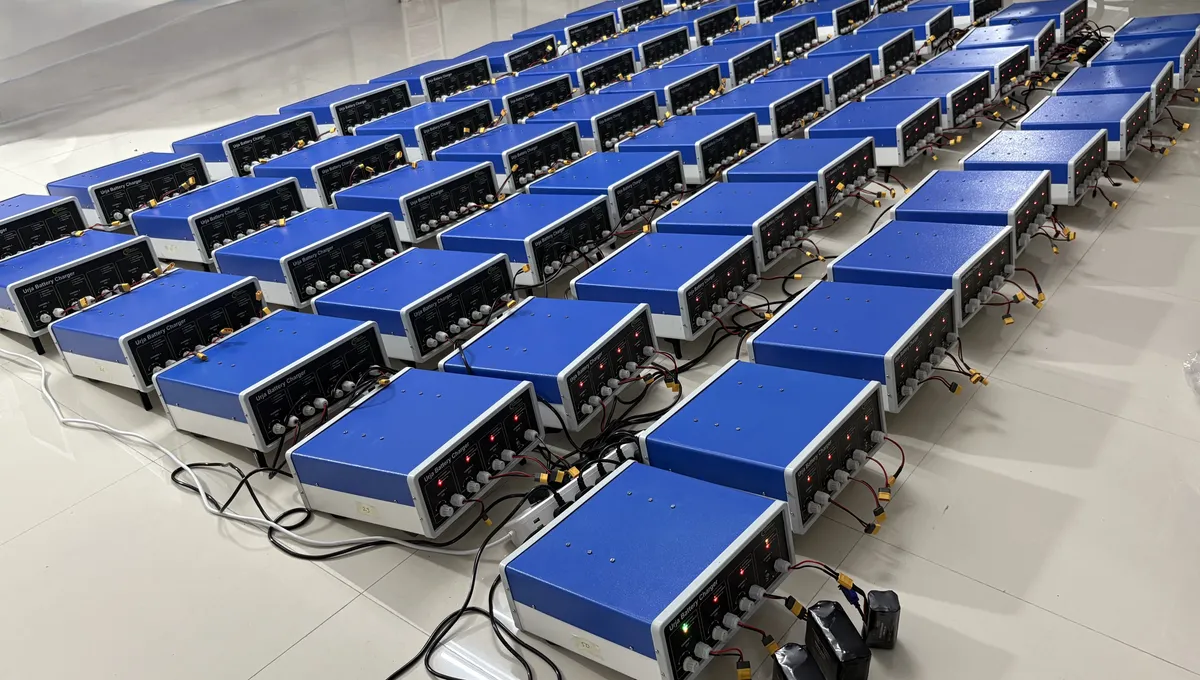 Drones & UAVs
Charging Infrastructure for Drone Logistics: The Part of the Network Nobody Designs First
Smart chargers, swap workflows, and fleet charging schedules — how to design the charging depot for a drone delivery network. Complete charging solutions made in India by Revogreen.
 Drones & UAVs
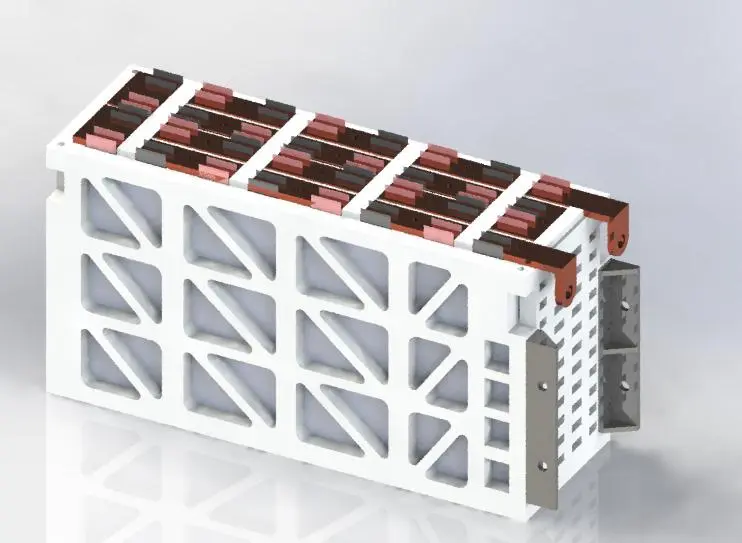
Logistics Drone Batteries: Every Gram of Battery Is a Gram of Payload You Can't Carry
Batteries for logistics and delivery drones — custom packs with quick-swap design, fast charging, smart BMS telemetry, and high cycle life for daily operations. Made in India by Revogreen.
 Drones & UAVs
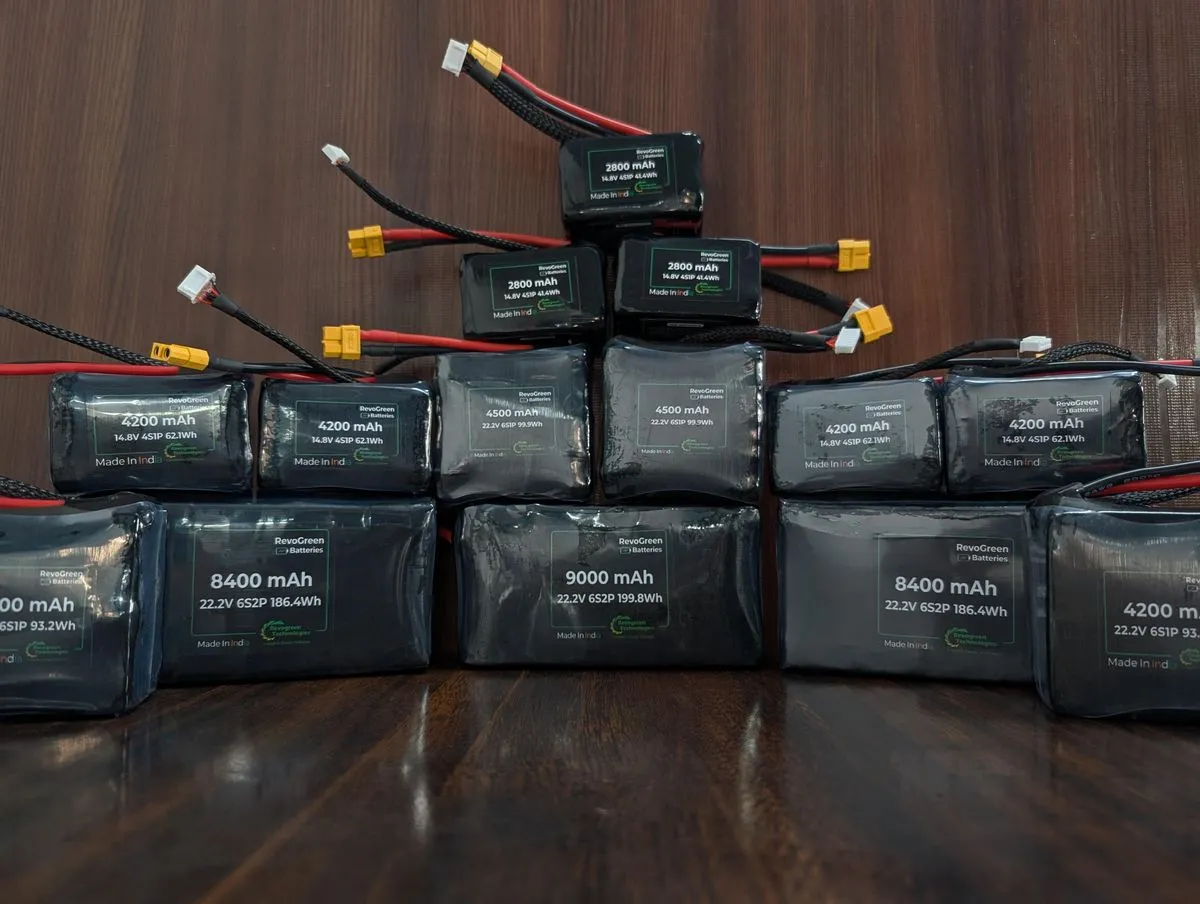
Custom Drone Batteries for OEMs: Build the Battery Around Your Drone, Not Your Drone Around the Battery
Building a drone? Get custom drone battery packs engineered for your platform — chemistry, form factor, smart BMS, telemetry, chargers, and power management. Made in India by Revogreen.