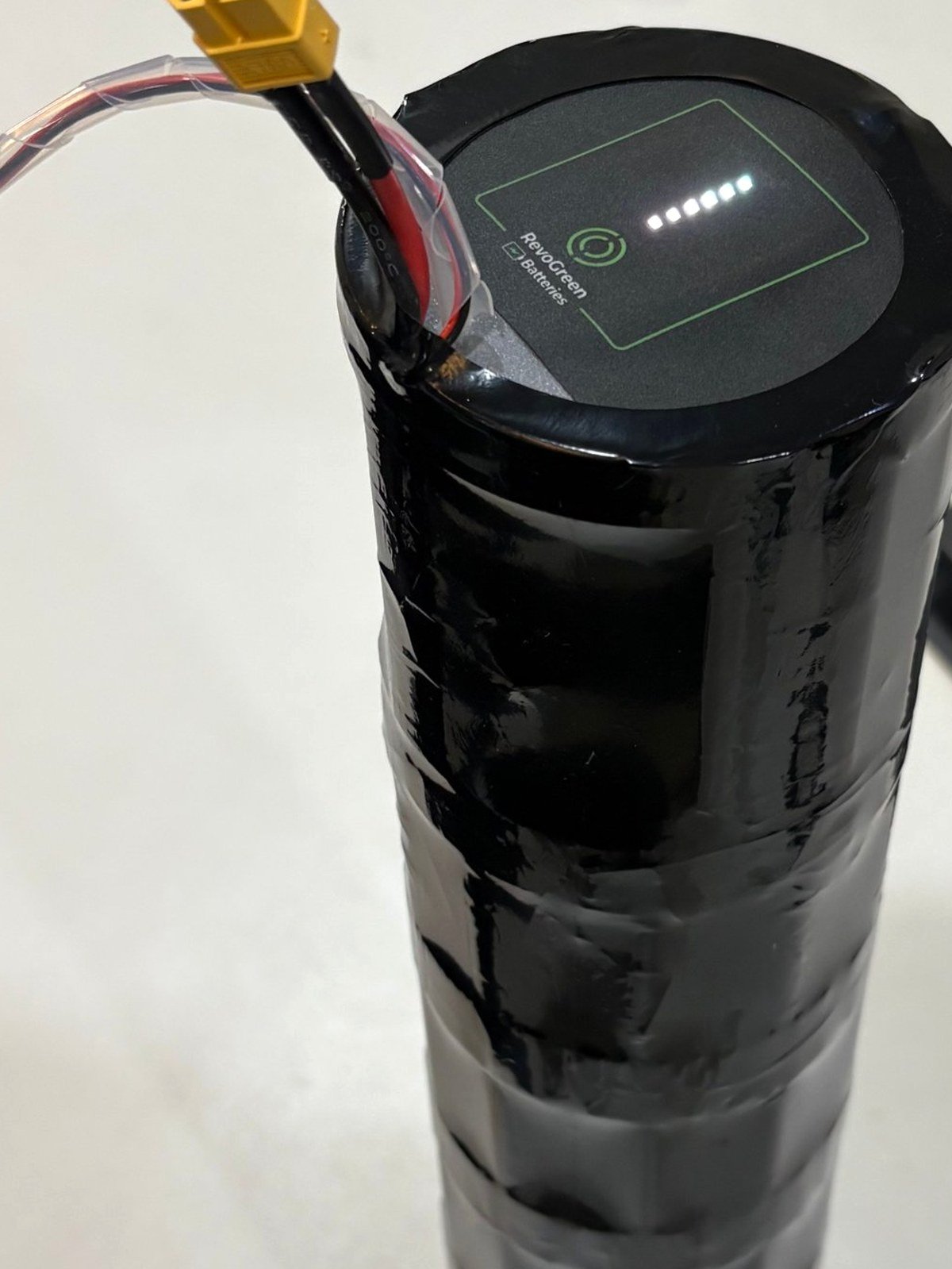
Battery Packs for Underwater Robotics at Depth: Engineering kWh-Class Power for AUVs, ROVs and Seabed Systems
An underwater vehicle is the hardest place to put a lithium battery. Once the vehicle is over the side, nobody can press a reset button or swap a fuse. The pack must carry the mission alone, a few degrees above freezing, inside a hull holding back tens or hundreds of bar. Every gram it adds must be bought back with foam or ballast.
Most AUV, ROV and seabed-lander teams learn this the expensive way. A pack borrowed from a ground robot trips a hard cutoff mid-transect or delivers half its rated energy after a cold soak. This post sets out what an underwater robotics battery pack must be designed for, so the requirement you send to a pack builder is complete the first time.
Two ways to survive the pressure: one-atmosphere housing or oil-filled pack
The housing decides the pack. The first of two approaches keeps the cells at one atmosphere inside a rigid vessel, usually an aluminium, titanium or composite tube with end caps. The second fills a flexible enclosure with dielectric oil, so the cells see ambient pressure directly.
One-atmosphere housings favour cylindrical cells. A dense block of cylindrical NMC or LFP cells with welded interconnects and damped mounting is the natural choice. The penalties are the mass of the vessel, which grows quickly with depth rating, and the need to manage vent gas from a cell failure inside a closed can.
Pressure-compensated packs favour pouch cells and potted electronics. Pouch cells tolerate external pressure when supported evenly. The BMS board and sense wiring must be potted to work immersed in oil, and any component with an air cavity, such as an electrolytic capacitor or a relay, must be designed out. Revogreen designs the cell block and electronics for either housing type, with potted electronics and reinforced interconnects, to fit the housing the vehicle supplies as standard building blocks. Our underwater robotics battery packs page lists the platform types we build for.
Buoyancy and trim: every watt-hour fights ballast
Energy density matters twice under water. A heavier pack in a submersible must be offset by syntactic foam or a larger hull. A pack 10 per cent denser in Wh per kg saves more than 10 per cent of vehicle mass once the foam needed to float it is counted. This is why NMC is the usual choice for long-endurance AUVs, while LFP suits seabed nodes that sit for years and cycle daily.
Mass placement is a design input. The battery is the largest mass in most vehicles, so its position sets the centre of gravity against the centre of buoyancy. A pack split into modules can be distributed fore and aft to trim the vehicle without lead. We ask for the hull layout and CG envelope at the requirement stage and shape the module count to it.
Higher-voltage subsea packs and why isolation matters more in seawater
Thruster power is pushing voltages up. Inspection-class ROVs still run at 48 V. Work-class vehicles and resident seabed systems now carry motor buses of several hundred volts, because cable and connector currents fall as voltage rises. Revogreen designs packs from 2S to 28S as standard smart-battery formats and high-voltage packs up to 400 V-class and beyond, built as series-connected modules, each with its own cell-monitoring electronics under a master BMS. The HV elements we engineer for include a pre-charge circuit, contactor control, an HV interlock loop, cell-level fusing and module-level thermal management.
Seawater turns a single fault into a circuit. On land, one insulation fault from a floating HV bus to chassis is harmless until a second fault occurs. In a conductive medium, a wet penetrator or cracked potting boundary offers a return path through the hull and the water itself. That corrodes metalwork and can present a shock hazard to divers and deck crew at recovery. Isolation monitoring on the pack side, reporting insulation resistance continuously over CAN, gives the vehicle time to abort a dive before the second fault happens. We treat it as mandatory on any subsea pack above 60 V. Our sister post on marine propulsion batteries for autonomous surface vessels covers the same HV architecture in a hull that stays dry.
Penetrators, connectors and proving the seal
The seal is a system, not a part. Power and data leave a housing through penetrators or wet-mate connectors, and every one is a failure point. The pack builder owns the wiring and strain relief up to the bulkhead; the housing and penetrators are the vehicle's: strain relief, correct wire gauge for the fill, and a potting boundary that will not crack under thermal cycling.
Validate by immersion and by cycling. A static leak test at rated depth is the easy part. The tests that catch failures are pressure cycling, repeated dives to depth and back with a dwell at each end, with an insulation-resistance check at every stage. Revogreen designs the pack to the customer's sealed housing and supports immersion and pressure-cycling acceptance of the assembled vehicle programme with documented test records.
Thermal behaviour inside a sealed hull
The ocean is a cold heat sink, if the pack can reach it. Below the thermocline, water sits at roughly 2 to 5 °C. A cell block bolted to the hull wall sheds discharge heat easily. A block sitting in air does not, and its core can climb while the hull outside stays cold. We design conduction paths from cell block to housing deliberately.
Cold sets the charging limit. Lithium-ion cells should not be charged below about 0 °C, because lithium plates on the anode and the cell is permanently weakened. A vehicle recharged in a seabed dock starts that charge cold. The BMS must read cell temperature and hold the charger to reduced current, or refuse charge, until the cells are warm enough. For discharge, our packs are cold-weather rated to −30 °C and validated to +60 °C soak. Our post on lithium battery performance in the cold goes deeper into capacity and impedance behaviour at low temperature.
Fail-safe BMS logic for a vehicle nobody can reach
A hard cutoff can lose the vehicle. A conventional BMS protects cells by opening the main switch on any fault. Under water, an open bus means no thrusters and possibly no drop-weight release. The safer behaviour for most faults is graceful derating: cap discharge current, tell the vehicle computer over CAN that endurance has changed, and let the mission planner turn for home. Only an imminent thermal event should trip the pack, and the abort-ballast circuit should sit on a separate protected rail.
Contain the fault at the cell. Cell-level fusing turns a shorted cell into one lost parallel string rather than a pack-level event. Propagation barriers between cell groups, with module-level monitoring, stop one hot cell taking its neighbours. Revogreen's smart BMS provides protection, balancing, state-of-charge and state-of-health estimation, temperature supervision and telemetry over CAN, SMBus, RS-485 or UART. Our guide to what a BMS actually does explains each function.
Endurance modelling, charging and turnaround
Model the mission, then size the pack. Vehicle power has three parts. Hotel load, the computers and navigation, is roughly constant and dominates a slow survey. Propulsion power rises with roughly the cube of speed, so a small drop in transit speed buys a large gain in range. Payload load, such as sonar, lights or manipulators, follows the duty cycle. Sum these over the mission in watt-hours, divide by the usable fraction of pack energy, typically 80 to 90 per cent, and derate again for temperature and end-of-life capacity. That figure, not the label kWh, is what the pack must deliver at end of service life.
Turnaround is a charger problem. On a ship, the vehicle must be ready for the next launch window. Revogreen supplies fast chargers and multi-battery chargers matched to the pack, with charge rate governed by the pack's own temperature and state-of-health data. How pack, BMS and charger work together is in our complete power solution post.
Made in India, engineered for naval and ocean-research programmes
Naval and research customers buy a documented, traceable power system that will pass an acceptance programme and be supportable for a decade. Revogreen Technologies, founded in Pune in 2021, has delivered more than 30,000 batteries to over 100 clients. Every pack ships with batch-level traceability and its own end-of-line test record, from incoming cell inspection through capacity, insulation and functional test. We design and document packs to support qualification to UN38.3 transport testing and IEC 62619, and we support indigenous-content requirements for Indian programmes. Prototypes are built in ones and tens and validated on the customer's vehicle before production. That is how we work across defence and aerospace and robotics and autonomous systems, and it is how we work under water. Made in India, shipped worldwide.
Looking for Custom Battery Solutions?
Revogreen Technologies designs application-specific battery systems for drones, defence, robotics, marine and industrial applications.
Get in Touch Marine & Underwater
Battery Packs for Autonomous Surface Vessels and Electric Marine Propulsion: From 48 V Workboats to 400 V Drive Systems
How to specify battery packs for autonomous surface vessels and electric marine propulsion: 48 V vs 400 V, modular kWh packs, IP68 sealing, HV isolation, LFP vs NMC.
Marine & UnderwaterROV Battery Replacement and Upgrade in India: More Dive Time, No Import Wait
Replacing or upgrading your ROV battery? Get a locally built lithium pack in India that fits your enclosure, with more runtime and a matched charger. Spares, upgrades and custom sizes from Revogreen.
 Marine & Underwater
ROV and Underwater Drone Battery Packs: Yes, We Build These
Need a battery for your ROV, underwater drone or AUV? Sealed lithium packs that fit standard enclosures, custom sizes, matched chargers. Designed and built in India by Revogreen.