High-Voltage Battery Packs for eVTOL and Electric Aircraft: What a 400 V Propulsion Pack Actually Involves
You are building an eVTOL, an air taxi or a small electric aircraft in India. The airframe and motors are moving forward. The propulsion battery is not. Every supplier you speak to either builds small drone packs or automotive packs that were never meant to fly. Neither is what you need.
A 400 V-class propulsion pack is not a big drone battery. It is a different engineering problem, with different failure modes, safety hardware and qualification path. This post explains what that pack involves, so you can judge whether a partner understands it. And to be direct: Revogreen designs and builds high-voltage battery packs at 400 V-class and higher, not only the 2S to 28S smart-battery formats you may have seen on our site.
Why an electric aircraft battery pack goes to 400 V or 800 V
Current is the enemy of mass. Power is voltage times current. A 200 kW hover demand at 50 V would need 4,000 A. At 400 V it needs 500 A, and at 800 V, 250 A. Cable cross-section, busbar mass, connector size and contactor rating all scale with current, not power. On an aircraft, every kilogram of copper is a kilogram not spent on payload or reserve energy.
Losses fall with the square of current. Conduction loss is I²R. Doubling the voltage halves the current and cuts loss in the same cable four times. That is heat you do not have to reject and energy you do not have to carry.
Motors and inverters prefer it. A higher DC bus lets the inverter switch lower current and the motor use higher winding voltage for the same torque. Silicon-carbide inverters in particular are built around 400 V and 800 V buses. The pack has to meet the powertrain there.
Series count arithmetic: how many cells make 400 V
Nominal voltage sets the series count. An NMC cell sits at roughly 3.6 to 3.7 V nominal, about 4.2 V at full charge and around 2.8 to 3.0 V at cut-off. A 400 V-class bus therefore needs about 96 to 110 cells in series. At 96S the pack runs about 350 V nominal and just over 400 V at full charge. At 110S it runs about 400 V nominal and 460 V full. The right number depends on the inverter's DC-link window, not on a round figure. An 800 V-class pack doubles this to roughly 192 to 220 cells in series.
Parallel groups set energy and C-rate. Every added parallel cell adds capacity and shares current. The parallel count must hold per-cell discharge current inside the cell's continuous and peak rating during hover, and deliver the kWh the mission needs. Cell selection balances energy density for range against power capability for takeoff. We usually look at NMC first, with high-drain Li-ion cells where power peaks dominate. The trade-offs are the same as in our guide on how to specify a custom battery pack, only larger.
Cell matching matters more at 100S. The weakest cell hits cut-off first and ends the flight. Incoming cell QC on capacity and internal resistance, then binning into matched modules, is not optional at this scale.
Modular architecture: modules, master BMS and isolated communication
No one builds a 100S pack as a single string. The practical unit is a module of perhaps 12S to 24S with its own cell-monitoring electronics. Modules are connected in series to reach the bus voltage, and a master BMS supervises them all. This is the architecture Revogreen uses for high-voltage packs. It keeps each monitoring circuit in a safe low-voltage window and makes a damaged module replaceable.
Each module measures its own cells. Cell voltage, balancing and multiple temperature sensors are handled at module level. The module reports to the master over an isolated link, because its reference potential can sit several hundred volts above chassis. Isolated CAN or an isolated daisy-chain keeps a module fault off the communication bus.
The master BMS owns the decisions. It aggregates module data, calculates pack state-of-charge and state-of-health, drives the contactors and talks to the flight control system over CAN. For a refresher on those functions, see what a BMS actually does. In a propulsion pack the consequences of a wrong decision are far higher, so redundant sensing and dual-path shutdown logic are part of the design.
HV safety hardware that a drone pack never needed
Contactors and pre-charge. A 400 V pack cannot be plugged in like a drone battery. The inverter's DC-link capacitors look like a short circuit at the instant of connection. A pre-charge circuit brings the link up through a resistor first, then the main contactors close, all sequenced by the master BMS.
Isolation monitoring. The HV bus must float from the airframe. An isolation monitor continuously measures resistance between HV-positive, HV-negative and chassis. A drop from moisture, chafing or coolant ingress is flagged before it becomes a shock or arc hazard.
HV interlock loop. A low-voltage loop runs through every HV connector and cover. Open any of them and the BMS drops the contactors before a conductor can be touched. This protects technicians as much as the aircraft.
Cell-level fusing. Each parallel cell carries a fusible link. If one cell shorts internally, its link opens and the group keeps working at reduced capacity, rather than dumping its full energy into the faulted cell. Revogreen designs all of these into high-voltage packs: isolation monitoring, pre-charge, contactor control, interlock loop and cell fusing.
Thermal runaway containment and the takeoff-cruise-landing profile
The mission profile is not flat. An eVTOL draws its highest power in hover and transition, at the start and end of the flight, and a fraction of that in cruise. The landing pulse arrives when the pack is at its lowest state-of-charge and highest internal resistance. Thermal design must be validated against that worst case, not the cruise average.
Propagation must stop at one cell. A single cell entering thermal runaway must not take its neighbours with it. That means thermal barriers between cells and modules, vent paths that carry hot gas out of the enclosure, and structure that survives the pressure event. Revogreen designs its high-voltage packs for thermal-runaway propagation containment at module level, and plans the containment validation with your programme's test authority.
Module-level thermal management. Air, cold plate or liquid cooling depends on the aircraft. Either way, every module needs its own temperature sensing and thermal path, so one hot module cannot hide behind a cool pack average.
State-of-health, reserve energy and diversion
Reserve energy is a flight-safety number. An aircraft must be able to divert to an alternate site with energy to spare. The battery must report remaining usable energy accurately enough to be trusted at low state-of-charge, low temperature and high load.
State-of-health decides when the pack is retired. Capacity fade and resistance growth reduce both range and the peak power available for landing. The master BMS tracks both and reports them over CAN so the operator can set conservative retirement thresholds. On-board logging gives the flight-by-flight history that a qualification programme and an incident investigation will both ask for.
Qualification support and the prototype-to-production path
Design for the qualification you will have to pass. An aircraft rechargeable lithium battery is typically assessed against DO-311A for the battery and DO-160 for environmental and EMI conditions. UN38.3 transport testing applies to every shipped pack. For unmanned aircraft in India, DGCA rules govern what can fly and how it is documented. Certification belongs to the aircraft programme, not the battery supplier. We design the pack, its protection logic and its documentation to support your qualification against them, and ship batch-level traceability and end-of-line test data with every pack.
Your first pack is a prototype. An eVTOL programme needs one or two packs for the iron bird, a handful for flight test and only then a production rate. Revogreen prototypes at low MOQ, in ones and tens, and validates on your platform before anything is frozen. Requirement capture happens under NDA, and production uses the same modules and test records as the prototype. If your programme is growing out of a drone platform, our companion post on scaling a drone battery to a high-voltage pack walks through the transition. The charger, ground equipment and data path are designed alongside the pack, which is why we describe our approach as a complete power solution of battery, BMS and charger rather than a pack alone.
Made in India, engineered for electric flight
Revogreen Technologies was founded in Pune in 2021. We have delivered more than 30,000 batteries to over 100 clients. The same team designs and builds everything from small smart packs for drones and UAVs to engineered, high-voltage modular pack designs for demanding special-purpose platforms. Every pack is built in India with incoming cell QC, end-of-line testing and documented test records, which supports indigenous-content requirements and keeps your engineering conversations local. Made in India, shipped worldwide.
Looking for Custom Battery Solutions?
Revogreen Technologies designs application-specific battery systems for drones, defence, robotics, marine and industrial applications.
Get in Touch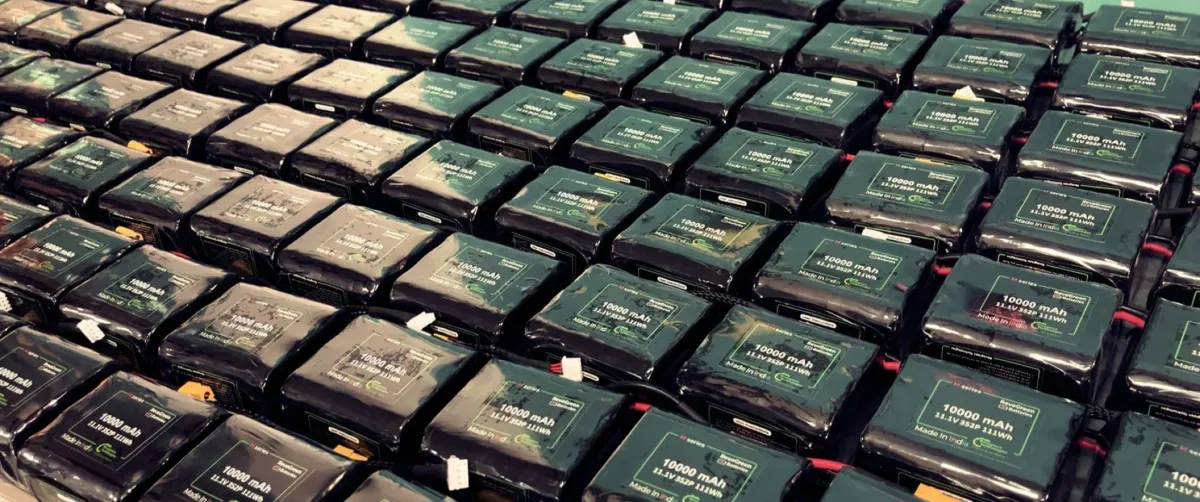 High Voltage
Scaling a Drone Battery to a High-Voltage Pack: What Changes From a 6S Pack to a 100-Cell System
What changes when a 6S drone battery grows into a 100-cell, 400 V-class pack: master/slave BMS, touch-safe design, HV manufacturing, hipot testing, HV charging.
 Special Purpose
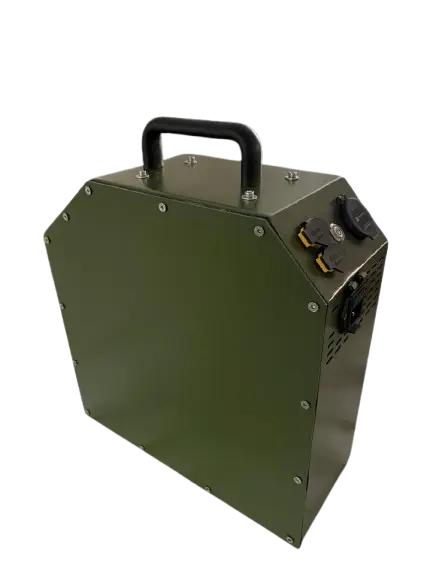
Batteries for Hyperloop Pods and Prototype Vehicles: High-Voltage Power for Platforms That Exist Only Once
High-voltage battery packs for hyperloop pods, prototype EVs and record vehicles: burst discharge, regen, vacuum-tube thermal design, HV safety, CAN telemetry and one-off builds.
 Defence
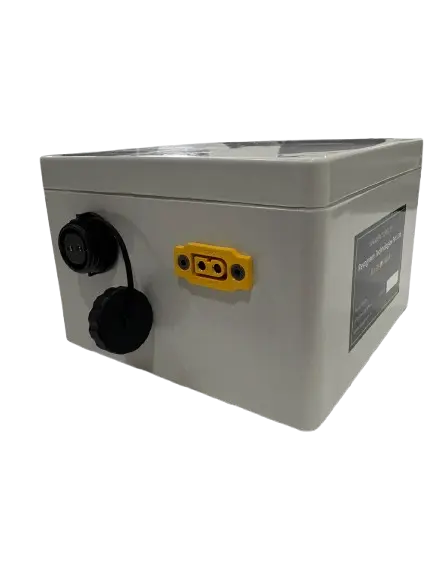
Batteries for Counter-UAS and Electronic Warfare Equipment: High-Drain Power That Doesn't Interfere With the Mission
How to power counter-drone and electronic warfare equipment: high-drain cells for transmit bursts, EMI-quiet BMS design, man-portable to site variants, fleet logistics.